Members
Ainsley Zhou Author
Behind the Green Door: Chapter Seven
by Ainsley Zhou on 11/08/2025
“We will not disturb the authors any further tonight,” said Albert. “We have had our warning and will heed it, but this is an opportune moment to make an important point concerning your mission.
“You must think of fiction as a work of creation in every sense of the word and accept the idea that characters from novels can escape the rigid confines of the role assigned by their author and assume an independent existence in the external world. They become a living, breathing person, possessed of free will, the same as you and me, with a life of their own.”
“Do they disappear from the novel?”
“No. The original character continues in their same role in the novel, never knowing that an alternative version of themselves has been created and lives in another dimension. The novel is completely unchanged. No doubt that is a startling revelation for you to consider as we walk to Blackwell’s?”
“Of course,” I replied.
But there was nothing to think over.
I believed every word he said.
We strolled into the town, passing rows of quaint-looking cars before we arrived outside the famous bookshop. We stood back so as not to be too conspicuous. Two undergraduates in short black academic gowns and holding textbooks were talking by the door, or more accurately, one was talking while the other, rather reluctantly, listened. The speaker was slim and angular with floppy black hair, which he continually flicked back with well-manicured fingers.
A poseur with a contrived manner that was desperately unoriginal. I had no interest in him; my attention focused on the second undergraduate. It was ‘Bob Cherry’, late of ‘The Remove’, at Greyfriars School, a leading character in one of my favourite childhood books.
Well, not exactly, but this chap looked just as I had imagined Bob to be.
Bob and his other friends appeared in a series of books about a schoolboy named Billy Bunter, a greedy but somehow likeable boy who was forever trying to pilfer cakes and sweet pastries belonging to other people. The boys lived and studied at an English boarding school called Greyfriars School, a sort of Hogwarts without the magic, where the school games were rugby and cricket rather than Quidditch.
My grandfather, who had read the books in his childhood, gave them to me, and I loved those stories when I was safely hidden away.
It seems that boys of whatever age or culture they are born into have a great deal in common. They enjoy the same sort of games and have the same sense of adventure; they even have the same sort of rivalry and problems dealing with authority. I identified issues that I had experienced at school myself, especially bullying.
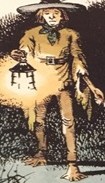
Bob Cherry.
One of my closest childhood companions, who lived within the pages of a book, was now a gilded youth at Oxford. He was tall, clean-cut, and wholesome-looking, with an open, honest face. His hair was neatly brushed and Brylcreemed, the same stuff that Albert had put on my hair.
Bob wore high-waisted, generously cut grey trousers with wide turn-ups that flapped a little in the breeze and highly polished black leather shoes. Under his gown was a clean white shirt and what must surely have been his old-school tie, fashioned in a Windsor knot.
He was the model for a whole generation, an ex-public schoolboy, and the product of the rigid class system of England of Earth Major up to the mid-twentieth century.
Bob Cherry at Oxford!
I now spoke to him face-to-face, although he could not see or hear me, of course.
“One of the heroes of my childhood, Bob, you, and your chums were my best friends. I was often lonely and had no other friends of my age, so your adventures at school were mine too. You don’t know how important you all are to me. I often used to hide away in a quiet place to get away from all the shouting in our house and lose myself in your adventures. I read every book in the series, and now I can see how you looked when you grew up.
“But you never grew up, did you, Bob? Not in the books, you didn’t. You will never know that in another world you will remain eternally fourteen years old.”
Albert touched my arm, indicating that it was time to go. I took one last look at ‘Bob’. I hoped that he would live a good life. An unexpected well of emotion caused me to stop for a moment, and I had to gather myself together before Albert noticed. We were dealing with real people and real lives here.
We walked further down the road and turned into Turl Street, home of two university colleges, Jesus and Exeter, and we walked halfway down and stopped on the right at a set of double oak doors set in the ancient stone wall.
Exeter College. Come in, Albert.”
We walked past the lodge, where a sleepy porter was dozing over a newspaper.
“This is the college I want to join. Do you think they will have me?”
“Not possible, Peregrine. You don’t exist here.”
“I do in this form.”
We stood in the quadrangle, and I pointed high up to the left of the building in front of us.
“See that window? 6:6. That’s where I am going to live.”
We walked through the quadrangle, down the narrow passageway on the right, and past the library into the Fellows’ Garden at the rear. Across the grass and up the crumbling stone steps at the bottom of the garden, we could see the roof of the Bodleian Library glinting in the sun. It was a perfect English summer day, with not a cloud in the sky.
“I’m going to study here, Albert, go to all the lectures, educate myself, and retire from the world.”
“Nice dream, Peregrine, but you can’t; it’s not possible; you can’t live here as a ghost, because that’s what you would be: a ghost, unable to talk to anybody, drifting about totally alone. Study? You wouldn’t be able to write a word or even pick up a book.”
“I could listen and think.”
“No, Peregrine, it’s not possible, and not only for the reasons I’ve mentioned. There is a physical limitation on the length of our stay here, and that time is up.”
The yellow door suddenly materialised in the middle of the lawn.
“Come on, take your last look; you may return one day,” said Albert as we stepped through the portal.
A moment later, we were back home and began changing our clothes.
“Thanks for a brilliant experience, Albert; it is something that I will never forget, and I learnt something. I am not sure exactly what it is, but it challenges any idea of an objective reality. Reality is the one you experience, and all these different realities are equally valid.”
“Something like that,” said Albert. “Now have your tea and try to get to bed early tonight.”
“Yes, of course, but may I ask you one last thing before I go?”
“Fire away, old boy,” he said, but I could see that he was concerned.
“Well, I met Montana for the first time yesterday. She told me about losing her parents so young, and I don’t want to accidentally say anything that might upset her. Can you tell me if there are any other subjects I should avoid? I am not just being curious; I would genuinely never want to hurt her, but I quite understand if you think it is too private to discuss.”
Albert looked relieved and smiled.
“No, Peregrine, your intentions are good, and I will pass on the little I know. Did she tell you her mother was Cheyenne?”
“Yes, and that her father was French Canadian.”
“He was a distant cousin of ours,” said Albert. “We have links to France in our family, and when he died, Ernest brought eight-year-old Montana back here from Earth Major as his ward. We gave her a home and sent her to a good school, and Ernest officially adopted her. She is a wonderfully kind and exceptionally talented young woman. Without any pressure from us, she developed a great interest in business, especially interdimensional travel.
“She believes that within her lifetime, we will come to understand the true nature of the multi-reality universe in which we live. Montana is not only exceptionally clever in the conventional sense, but she also has advanced emotional intelligence and a gift for intuitive understanding that goes far beyond the limits of rationality and science.”
I agreed.
“Yes, even in the brief time that we spent together, I think I sensed that otherworldliness about her.”
“You have a natural empathy, Peregrine. Did she tell you how she got her name?”
“No, only that it suits her.”
“Yes, it does. Her mother was one of the Indigenous peoples of America, and she named Montana in honour of the southeastern part of the state, which was home to her maternal family. I hope you will be her friend, Peregrine; she needs the company of somebody her age.”
“I will, Mr Albert. I will.”
Never before have I spoken with such sincerity.
I could not think of a life without her, but it was going to be hard to keep us together, or even in the same world.